18+. Full T&C's apply. Sports bonus: 100% match up to $500. Casino bonus: 100% match up to $500. Enter promo code NEW200 at deposit and get up to a $1000 bonus. Valid on your first three (3) deposits. Available for all deposit methods. Minimum deposit of $50.
18+. Full terms apply. The Bet Back Bonus is available for new customers on first-time deposits of $50 or more. To redeem, select the offer in the cashier while completing your first deposit. Make your pick(s) in the Sportsbook and then select ‘Opt In to Use Your Bonus’. A Bet Back Bonus pop-up will display, select ‘Claim’ and then enter the risk amount to place your bet. If it wins, you keep your profits. If it loses, get 100% of your risk refunded as Free Play with only 1-time rollover. Free Play can then be used to place bets in the Sportsbook and earn cash. Additional T&Cs apply, please visit MyBookie to access the Help Center or contact Live Chat for more details.
18+. Full T&C's apply. This promotion is available only to new accounts in North America. Freeplay amount must be wagered five times (5x rollover) before it becomes eligible for withdrawal. Only prematch (sportsbook) bets count toward the 5x rollover requirement. Each person may claim only one bonus. If a customer creates multiple accounts to exploit this promotion, bet105 will mark all related accounts as ineligible and reclaim the funds. If a client receives more than two free bets without making a deposit, any winnings from those bets will be forfeited. This promotion applies only to the initial deposit or if specifically assigned by bet105.
18+. Full terms apply. New BUSR members only. Minimum deposit of $50 required per qualifying deposits. Codes 300SB1, 300SB2, and 300SB3 must be entered at the time of each corresponding deposit.
Each code is valid one time only. Each bonus code must be claimed at least 24 hours apart. Only one promo code may be applied per deposit. A 20x rollover requirement applies to the combined total of your initial deposit and bonus before any withdrawal can be made. Redeemable in the Sportsbook only. BUSR management reserves the right to modify, suspend, or cancel this promotion at any time. Redeem each promo code in the cashier to get your bonus. Must be 18 or older. Please gamble responsibly. General House Rules Apply.
18+. Full terms apply. 100% up to $500 Bonus. Valid for non-crypto payment methods only. Minimum deposit amount $50. This offer is not available to customers from Canada or Mexico. The bonus code must be redeemed immediately after the deposit and before a wager has been placed. The sum of the deposit and the bonus are subject to rollover requirements of 12x at min. odds of -200 (1.5) before a new code can be redeemed. Max. $500 of each bet count towards the rollover requirements. Only bets placed on options that take place count towards the rollover requirements. Wagers on Horse Racing and Boosted Odds do not count towards the rollover requirements. All general Everygame Sportsbook rules apply.
21+. Full T&C's apply. Bonus: 35% of qualifying deposit, up to $105. Rollover: 8× (only sports action counts towards the rollover) deposit + bonus. Expiry: 7 days after credit. Hold period: 2 weeks. Payouts allowed only after rollover and hold period are completed. Example: Deposit $200 → Receive $50 Sports Free Play. Sports Free Play Rules: see the BetAnything General Reward Rules for eligible sports, wager types, odds, and rollover rules.
18+. Full T&C's apply. This bonus can only be redeemed on your first deposit. Rollover is 5x Sports/5x Horses/30x Casino on both the initial deposit and the bonus amount. Rollover in our Sportsbook, for winning wagers, will be determined by the lesser of your risk or win amount at the time of wager settlement; for losing wagers your risk amount will be credited to your rollover contribution. Bonus funds cannot be used for play on Live Dealer games. Live Dealer play does not count toward meeting Casino rollover requirements for withdrawal. If a withdrawal is made before the bonus terms are met, all bonus funds as well as any money earned by wagering the bonus will be forfeited.
The score alone does not settle every double-chance bet.
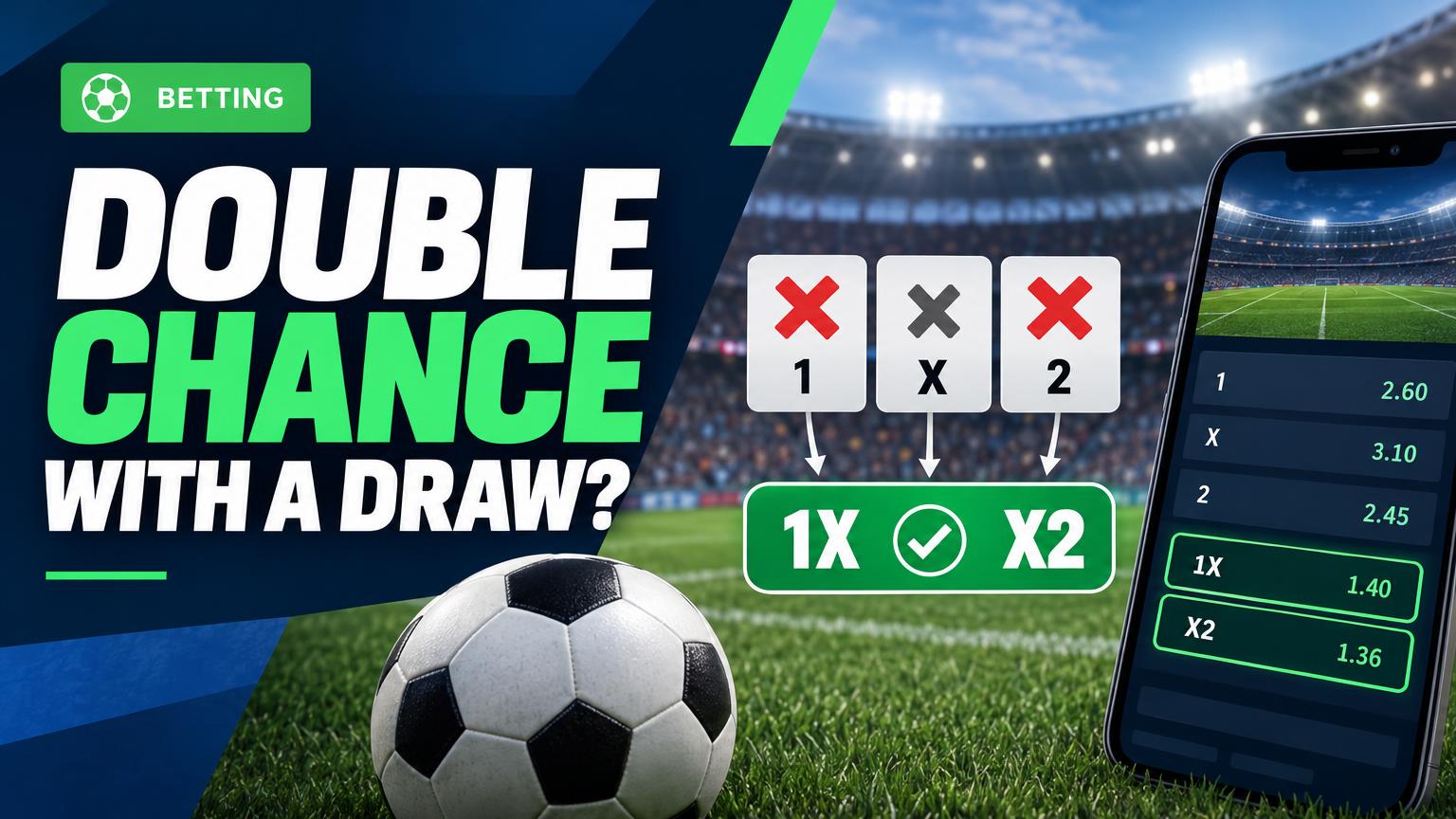
The referee blows the final whistle at 1–1, but the double-chance ticket still needs decoding. Check the selection: 1X covers a home win or draw, and X2 covers an away win or draw. Either wins when the match ends level. 12 covers a home or away win, so a draw loses.
The X is the key: it means draw, not a third team or an extra period. Soccer double-chance bets typically settle on the result after 90 minutes plus stoppage time. Extra time and penalties usually do not count unless the sportsbook’s market rules say otherwise.
Read the letters, not the score
A soccer match has three standard results: 1 means the home team wins, X means a draw, and 2 means the away team wins. These are result labels, not scores. For readers new to the notation, it helps to start with how soccer wagers work before reading a double-chance ticket.
A double-chance selection combines two of those results:
Pick
Results covered
Result that loses
1X
Home win or draw
Away win
X2
Draw or away win
Home win
12
Home win or away win
Draw
The X is the deciding detail when a match ends level. Both 0–0 and 2–2 are draws, so either score wins for 1X or X2 and loses for 12. The number of goals does not change which result the ticket covers.
Likewise, 12 does not mean a 1–2 score. It means either team must win. Checking the pick’s letters against the three possible results is more reliable than trying to interpret them as a predicted score.
Which results win each double-chance bet?
Each double-chance selection covers two of the three possible match results. The score examples below show how the bets settle; the home team’s score appears first.
Selection
Winning results
Losing result
1X
Home win (1–0); draw (1–1)
Away win (0–1)
X2
Draw (1–1); away win (0–1)
Home win (1–0)
12
Home win (1–0); away win (0–1)
Draw (1–1)
A draw wins for both 1X and X2, but loses for 12. That applies to a scoreless 0–0 just as it does to 1–1: the X refers to a level result, not a particular score.
The 12 selection is sometimes mistaken for a bet that both teams will score. It means the opposite of a draw: either team must win. A 1–0 result wins a 12 bet even though only one team scored; a 1–1 result loses despite goals from both sides. “Both teams to score” is a separate market with a different condition.
What happens to each bet at 1–1?
Suppose a match finishes 1–1 after 90 minutes plus stoppage time. The draw counts as X, so both selections containing X win. The selection that excludes X loses.
Final score
1X (home or draw)
X2 (draw or away)
12 (home or away)
1–1
Win
Win
Loss
2–1
Win
Loss
Win
1–2
Loss
Win
Win
If a bettor placed a separate stake on each selection, the winning 1X and X2 bets would pay at their respective accepted odds. The losing 12 bet would forfeit its stake. A draw does not mean all three bets are refunded, and two winning selections do not necessarily make the combined bets profitable; that depends on their odds and stakes.
The other scores confirm the pattern. At 2–1, the home win makes 1X and 12 winners. At 1–2, the away win makes X2 and 12 winners. For an ordinary double-chance market settled on the regulation-time result, 1–1 needs no tiebreaker: the draw itself is the result.
Top Sportsbook Picks for November 2026
BetUS
200% up to $1,000
Code:
NEW200
18+. Full T&C's apply.
18+. Full T&C's apply. Sports bonus: 100% match up to $500. Casino bonus: 100% match up to $500. Enter promo code NEW200 at deposit and get up to a $1000 bonus. Valid on your first three (3) deposits. Available for all deposit methods. Minimum deposit of $50.
18+. Full terms apply. The Bet Back Bonus is available for new customers on first-time deposits of $50 or more. To redeem, select the offer in the cashier while completing your first deposit. Make your pick(s) in the Sportsbook and then select ‘Opt In to Use Your Bonus’. A Bet Back Bonus pop-up will display, select ‘Claim’ and then enter the risk amount to place your bet. If it wins, you keep your profits. If it loses, get 100% of your risk refunded as Free Play with only 1-time rollover. Free Play can then be used to place bets in the Sportsbook and earn cash. Additional T&Cs apply, please visit MyBookie to access the Help Center or contact Live Chat for more details.
18+. Full T&C's apply. This promotion is available only to new accounts in North America. Freeplay amount must be wagered five times (5x rollover) before it becomes eligible for withdrawal. Only prematch (sportsbook) bets count toward the 5x rollover requirement. Each person may claim only one bonus. If a customer creates multiple accounts to exploit this promotion, bet105 will mark all related accounts as ineligible and reclaim the funds. If a client receives more than two free bets without making a deposit, any winnings from those bets will be forfeited. This promotion applies only to the initial deposit or if specifically assigned by bet105.
18+. Full terms apply. New BUSR members only. Minimum deposit of $50 required per qualifying deposits. Codes 300SB1, 300SB2, and 300SB3 must be entered at the time of each corresponding deposit.
Each code is valid one time only. Each bonus code must be claimed at least 24 hours apart. Only one promo code may be applied per deposit. A 20x rollover requirement applies to the combined total of your initial deposit and bonus before any withdrawal can be made. Redeemable in the Sportsbook only. BUSR management reserves the right to modify, suspend, or cancel this promotion at any time. Redeem each promo code in the cashier to get your bonus. Must be 18 or older. Please gamble responsibly. General House Rules Apply.
18+. Full terms apply. 100% up to $500 Bonus. Valid for non-crypto payment methods only. Minimum deposit amount $50. This offer is not available to customers from Canada or Mexico. The bonus code must be redeemed immediately after the deposit and before a wager has been placed. The sum of the deposit and the bonus are subject to rollover requirements of 12x at min. odds of -200 (1.5) before a new code can be redeemed. Max. $500 of each bet count towards the rollover requirements. Only bets placed on options that take place count towards the rollover requirements. Wagers on Horse Racing and Boosted Odds do not count towards the rollover requirements. All general Everygame Sportsbook rules apply.
21+. Full T&C's apply. Bonus: 35% of qualifying deposit, up to $105. Rollover: 8× (only sports action counts towards the rollover) deposit + bonus. Expiry: 7 days after credit. Hold period: 2 weeks. Payouts allowed only after rollover and hold period are completed. Example: Deposit $200 → Receive $50 Sports Free Play. Sports Free Play Rules: see the BetAnything General Reward Rules for eligible sports, wager types, odds, and rollover rules.
18+. Full T&C's apply. This bonus can only be redeemed on your first deposit. Rollover is 5x Sports/5x Horses/30x Casino on both the initial deposit and the bonus amount. Rollover in our Sportsbook, for winning wagers, will be determined by the lesser of your risk or win amount at the time of wager settlement; for losing wagers your risk amount will be credited to your rollover contribution. Bonus funds cannot be used for play on Live Dealer games. Live Dealer play does not count toward meeting Casino rollover requirements for withdrawal. If a withdrawal is made before the bonus terms are met, all bonus funds as well as any money earned by wagering the bonus will be forfeited.
For a standard soccer double-chance bet, the result is taken after 90 minutes plus stoppage time. Stoppage time is the added time shown at the end of each half; it is part of regulation play. The two additional periods used in some knockout matches are extra time, and a penalty shootout comes later still.
Suppose a cup match is tied 1–1 at the end of stoppage time, but one team wins 2–1 in extra time. Standard double-chance bets settle on the 1–1 draw: 1X and X2 win, while 12 loses. The later winner does not rewrite the regulation-time result.
Market wording matters more than the final headline score. A to qualify bet may depend on which team advances, including through a shootout. A separately labeled extra-time result market instead uses the period specified in its rules. Checking the market name and settlement terms before placing a bet is the clearest way to tell which result counts.
If the match does not finish as scheduled
Postponed and abandoned matches follow the sportsbook’s published rules. Depending on those terms and when play resumes, a bet may stand or be voided; the score when play stopped does not settle every market automatically.
Why does double chance pay less?
A double-chance bet covers two of the three possible match results, so it generally has shorter odds than backing either covered result alone. For example, 1X wins if the home team wins or the match ends level; a home-win bet needs the home team to win. That extra coverage usually means a smaller return for the same stake.
Payout still depends on the odds accepted when the bet is placed. With decimal odds, the total return on a winning bet is the stake multiplied by those odds; that figure includes the original stake. The sportsbook’s margin is also built into its prices, so the offered odds will not simply reflect a neutral estimate of each outcome’s likelihood.
Not all double-chance selections in a match carry the same price. If one team is heavily favored, covering that team and the draw may pay less than covering the underdog and the draw. Either way, two covered outcomes leave a third result that loses: broader coverage reduces the ways a bet can fail, but it does not make the match predictable.
Double chance vs. draw no bet
A draw pays one market, refunds another, and defeats the third.
Suppose a soccer match finishes 1–1 after regulation time. A 1X bet wins because the home team did not lose; an X2 bet wins because the away team did not lose. Either selection pays at its accepted odds. A 12 bet loses because neither team won.
A home or away draw-no-bet wager handles that same result differently: the sportsbook generally returns the original stake, with no winnings. That makes draw no bet a refund alternative to choosing 1X or X2 when the draw is a concern, rather than another way to get paid for one.
Selection on a 1–1 draw
Typical result
1X or X2
Wins at accepted odds
Home or away draw no bet
Stake returned
12
Loses
The distinction matters when comparing odds. Double chance covers two outcomes as wins, so its offered odds are generally shorter than a comparable draw-no-bet selection. Draw no bet covers a team victory as a win but treats the draw as a push. By contrast, 12 offers no draw protection at all: it needs either team to win, regardless of which one was favored. Settlement terms can vary by sportsbook, so the market name and rules are worth checking before placing a bet.
FAQs
Common double-chance settlement questions
Does 0–0 count as a draw?
Yes. If 0–0 is the score at the end of the market’s settlement period, 1X and X2 win because both include the draw. A 12 bet loses because neither team won.
Does a goal in stoppage time count?
Yes. Stoppage time is part of regulation time, so a goal before the final whistle can change the result used to settle a standard full-time double-chance bet. Extra time is a separate period and is normally excluded.
Does a 12 selection pick a particular team?
No. The 1 covers the home win, and the 2 covers the away win; 12 wins if either team wins during the stated settlement period. It loses if that period ends level.
What if the match is tied at halftime but not at full time?
A standard full-time double-chance bet settles on the full-time result, not the halftime score. A bet explicitly labeled as a first-half market instead settles on the first-half result.
Step List
Check the selection
The bet slip should show 1X, X2, or 12. Only 1X and X2 include X, the draw.
Check the settlement period
Confirm whether the market covers the full match or a half. Standard full-match bets generally include stoppage time but exclude extra time and shootouts.
Check the accepted odds
The odds on the accepted bet slip determine the payout, not odds displayed later.
Check the void rules
Review the sportsbook’s terms for postponed, abandoned, or otherwise interrupted matches. Those rules can determine whether the bet stands or the stake is returned.
Conclusion
Under standard double-chance terms, a draw wins for 1X and X2 but loses for 12. The accepted bet slip and the sportsbook’s specific market rules control settlement when a match or market falls outside the standard case.
Top Sportsbook Picks for November 2026
BetUS
200% up to $1,000
Code:
NEW200
18+. Full T&C's apply.
18+. Full T&C's apply. Sports bonus: 100% match up to $500. Casino bonus: 100% match up to $500. Enter promo code NEW200 at deposit and get up to a $1000 bonus. Valid on your first three (3) deposits. Available for all deposit methods. Minimum deposit of $50.
18+. Full terms apply. The Bet Back Bonus is available for new customers on first-time deposits of $50 or more. To redeem, select the offer in the cashier while completing your first deposit. Make your pick(s) in the Sportsbook and then select ‘Opt In to Use Your Bonus’. A Bet Back Bonus pop-up will display, select ‘Claim’ and then enter the risk amount to place your bet. If it wins, you keep your profits. If it loses, get 100% of your risk refunded as Free Play with only 1-time rollover. Free Play can then be used to place bets in the Sportsbook and earn cash. Additional T&Cs apply, please visit MyBookie to access the Help Center or contact Live Chat for more details.
18+. Full T&C's apply. This promotion is available only to new accounts in North America. Freeplay amount must be wagered five times (5x rollover) before it becomes eligible for withdrawal. Only prematch (sportsbook) bets count toward the 5x rollover requirement. Each person may claim only one bonus. If a customer creates multiple accounts to exploit this promotion, bet105 will mark all related accounts as ineligible and reclaim the funds. If a client receives more than two free bets without making a deposit, any winnings from those bets will be forfeited. This promotion applies only to the initial deposit or if specifically assigned by bet105.
18+. Full terms apply. New BUSR members only. Minimum deposit of $50 required per qualifying deposits. Codes 300SB1, 300SB2, and 300SB3 must be entered at the time of each corresponding deposit.
Each code is valid one time only. Each bonus code must be claimed at least 24 hours apart. Only one promo code may be applied per deposit. A 20x rollover requirement applies to the combined total of your initial deposit and bonus before any withdrawal can be made. Redeemable in the Sportsbook only. BUSR management reserves the right to modify, suspend, or cancel this promotion at any time. Redeem each promo code in the cashier to get your bonus. Must be 18 or older. Please gamble responsibly. General House Rules Apply.
18+. Full terms apply. 100% up to $500 Bonus. Valid for non-crypto payment methods only. Minimum deposit amount $50. This offer is not available to customers from Canada or Mexico. The bonus code must be redeemed immediately after the deposit and before a wager has been placed. The sum of the deposit and the bonus are subject to rollover requirements of 12x at min. odds of -200 (1.5) before a new code can be redeemed. Max. $500 of each bet count towards the rollover requirements. Only bets placed on options that take place count towards the rollover requirements. Wagers on Horse Racing and Boosted Odds do not count towards the rollover requirements. All general Everygame Sportsbook rules apply.
21+. Full T&C's apply. Bonus: 35% of qualifying deposit, up to $105. Rollover: 8× (only sports action counts towards the rollover) deposit + bonus. Expiry: 7 days after credit. Hold period: 2 weeks. Payouts allowed only after rollover and hold period are completed. Example: Deposit $200 → Receive $50 Sports Free Play. Sports Free Play Rules: see the BetAnything General Reward Rules for eligible sports, wager types, odds, and rollover rules.
18+. Full T&C's apply. This bonus can only be redeemed on your first deposit. Rollover is 5x Sports/5x Horses/30x Casino on both the initial deposit and the bonus amount. Rollover in our Sportsbook, for winning wagers, will be determined by the lesser of your risk or win amount at the time of wager settlement; for losing wagers your risk amount will be credited to your rollover contribution. Bonus funds cannot be used for play on Live Dealer games. Live Dealer play does not count toward meeting Casino rollover requirements for withdrawal. If a withdrawal is made before the bonus terms are met, all bonus funds as well as any money earned by wagering the bonus will be forfeited.