18+. Full T&C's apply. Sports bonus: 100% match up to $500. Casino bonus: 100% match up to $500. Enter promo code NEW200 at deposit and get up to a $1000 bonus. Valid on your first three (3) deposits. Available for all deposit methods. Minimum deposit of $50.
18+. Full terms apply. The Bet Back Bonus is available for new customers on first-time deposits of $50 or more. To redeem, select the offer in the cashier while completing your first deposit. Make your pick(s) in the Sportsbook and then select ‘Opt In to Use Your Bonus’. A Bet Back Bonus pop-up will display, select ‘Claim’ and then enter the risk amount to place your bet. If it wins, you keep your profits. If it loses, get 100% of your risk refunded as Free Play with only 1-time rollover. Free Play can then be used to place bets in the Sportsbook and earn cash. Additional T&Cs apply, please visit MyBookie to access the Help Center or contact Live Chat for more details.
18+. Full T&C's apply. This promotion is available only to new accounts in North America. Freeplay amount must be wagered five times (5x rollover) before it becomes eligible for withdrawal. Only prematch (sportsbook) bets count toward the 5x rollover requirement. Each person may claim only one bonus. If a customer creates multiple accounts to exploit this promotion, bet105 will mark all related accounts as ineligible and reclaim the funds. If a client receives more than two free bets without making a deposit, any winnings from those bets will be forfeited. This promotion applies only to the initial deposit or if specifically assigned by bet105.
18+. Full terms apply. New BUSR members only. Minimum deposit of $50 required per qualifying deposits. Codes 300SB1, 300SB2, and 300SB3 must be entered at the time of each corresponding deposit.
Each code is valid one time only. Each bonus code must be claimed at least 24 hours apart. Only one promo code may be applied per deposit. A 20x rollover requirement applies to the combined total of your initial deposit and bonus before any withdrawal can be made. Redeemable in the Sportsbook only. BUSR management reserves the right to modify, suspend, or cancel this promotion at any time. Redeem each promo code in the cashier to get your bonus. Must be 18 or older. Please gamble responsibly. General House Rules Apply.
18+. Full terms apply. 100% up to $500 Bonus. Valid for non-crypto payment methods only. Minimum deposit amount $50. This offer is not available to customers from Canada or Mexico. The bonus code must be redeemed immediately after the deposit and before a wager has been placed. The sum of the deposit and the bonus are subject to rollover requirements of 12x at min. odds of -200 (1.5) before a new code can be redeemed. Max. $500 of each bet count towards the rollover requirements. Only bets placed on options that take place count towards the rollover requirements. Wagers on Horse Racing and Boosted Odds do not count towards the rollover requirements. All general Everygame Sportsbook rules apply.
21+. Full T&C's apply. Bonus: 35% of qualifying deposit, up to $105. Rollover: 8× (only sports action counts towards the rollover) deposit + bonus. Expiry: 7 days after credit. Hold period: 2 weeks. Payouts allowed only after rollover and hold period are completed. Example: Deposit $200 → Receive $50 Sports Free Play. Sports Free Play Rules: see the BetAnything General Reward Rules for eligible sports, wager types, odds, and rollover rules.
18+. Full T&C's apply. This bonus can only be redeemed on your first deposit. Rollover is 5x Sports/5x Horses/30x Casino on both the initial deposit and the bonus amount. Rollover in our Sportsbook, for winning wagers, will be determined by the lesser of your risk or win amount at the time of wager settlement; for losing wagers your risk amount will be credited to your rollover contribution. Bonus funds cannot be used for play on Live Dealer games. Live Dealer play does not count toward meeting Casino rollover requirements for withdrawal. If a withdrawal is made before the bonus terms are met, all bonus funds as well as any money earned by wagering the bonus will be forfeited.
The number on the ticket matters as much as the team on it.
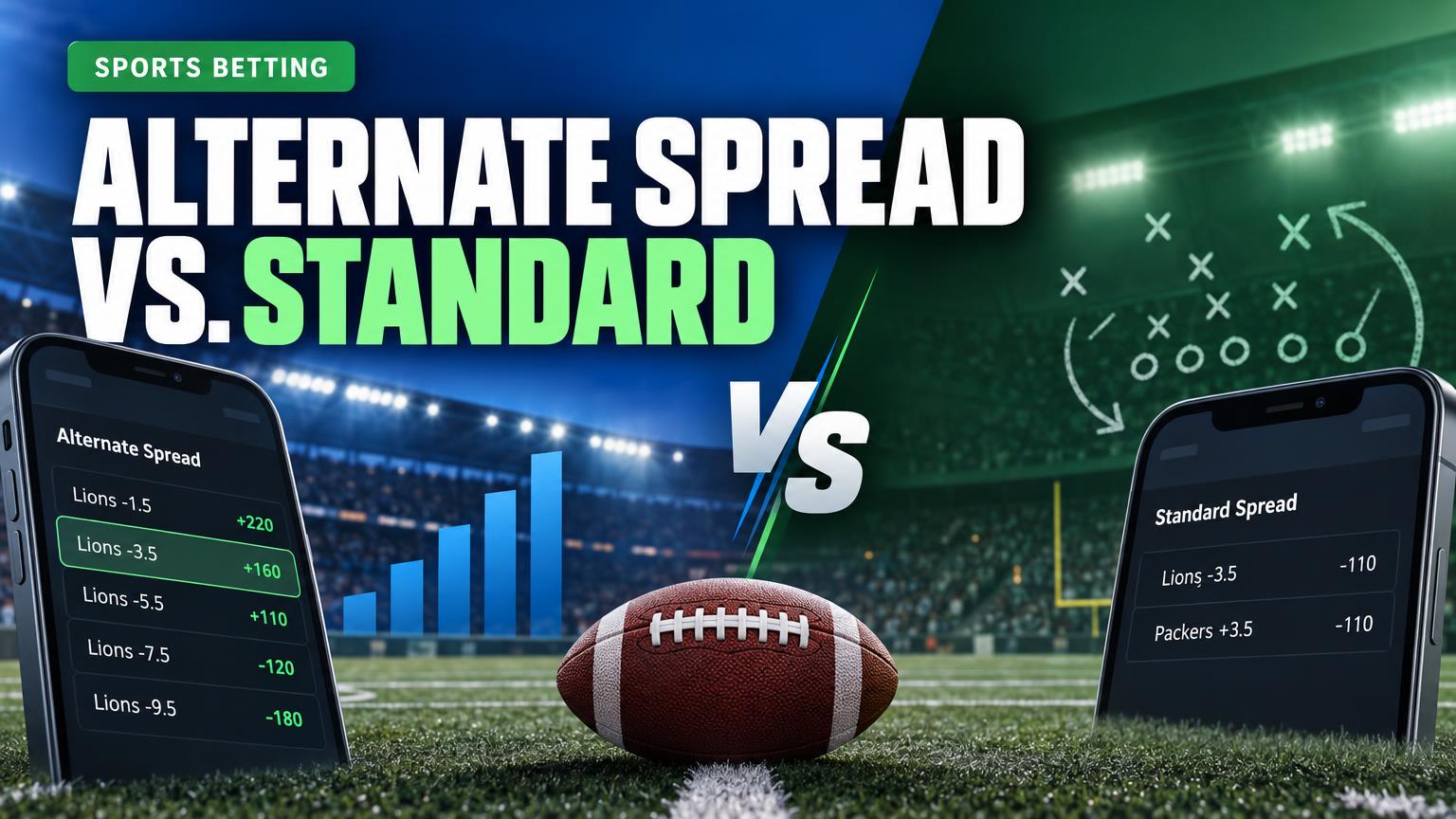
A favorite listed at -3.5 must win by at least four points for a standard spread bet to cash. Moving to an alternate -1.5 means a two-point win is enough, but the sportsbook typically offers a smaller return. At -6.5, the favorite needs a seven-point win; the potential return grows because that result is less likely.
The trade-off works in reverse for underdogs: more points generally mean a smaller return, while fewer points mean a larger one. Compare the line and the odds together. An alternate spread changes what must happen for the bet to win, not just what it pays. Neither line is automatically better value; that depends on whether the odds fairly reflect the chance of covering.
What an alternate spread changes
The standard spread is the sportsbook’s main point handicap for a game. If a favorite is listed at −3.5, it must win by at least four points to cover. The underdog at +3.5 covers by winning outright or losing by no more than three. An alternate spread keeps the same matchup but moves that handicap to another number.
Suppose the favorite is also available at −6.5. A 27–21 win covers the standard −3.5 line, but not the alternate −6.5 line; the underdog at +6.5 would cover instead. Moving the favorite’s line to −1.5 makes it easier to cover, while moving it to −6.5 makes it harder. The odds generally adjust with that difficulty: an easier line tends to pay less, and a harder one tends to pay more. The posted odds matter as much as the margin.
A spread is settled against the difference between the teams’ scores, not either team’s score alone. That makes it distinct from betting on one team’s points, where the result depends on whether that team clears a specified scoring total. On a whole-number spread, an exact-margin result may be a push, depending on the sportsbook’s rules.
How final scores change the result
The table uses hypothetical lines and final scores, with the favorite’s score listed first. The standard spread is favorite -3; the alternate spreads are -1.5 and -7. Each outcome applies only to a bet on the favorite at that line.
Hypothetical final score
Margin
Standard: -3
Alternate: -1.5
Alternate: -7
23–21
2
Loss
Win
Loss
24–21
3
Push
Win
Loss
27–21
6
Win
Win
Loss
28–21
7
Win
Win
Push
31–21
10
Win
Win
Win
Moving from -3 to -1.5 expands the winning range: a two-point victory now covers, and a three-point victory wins rather than pushes. Moving to -7 narrows it: even a six-point victory loses, while a seven-point victory pushes. At a whole-number spread, a push means the final margin lands exactly on the line; the stake is typically returned, subject to the sportsbook’s rules.
The table shows settlement, not value. An easier spread generally comes with less favorable odds, while a harder spread generally offers a larger potential payout. Those prices matter: a line that wins across more final scores is not automatically the better bet. Before comparing options, it helps to check both the required margin and the odds attached to each line.
How the odds change with the spread
A more forgiving spread usually comes with a smaller return. If a favorite moves from -3.5 to -1.5, it has more ways to cover, so the sportsbook generally charges more for that outcome. Moving the favorite to -6.5 does the opposite: it must win by more, but the potential return generally rises.
The displayed odds put numbers on that trade-off. In a hypothetical market, a favorite might be -110 at -3.5, -160 at -1.5, and +150 at -6.5. At -160, a winning bet returns less profit relative to the stake than it would at -110; at +150, it returns more. Actual lines and odds vary by book and can move before kickoff.
Those prices also imply break-even probabilities: roughly 52.4% at -110, 61.5% at -160, and 40% at +150. For a bet to have value on its own terms, its estimated chance of winning must exceed the break-even probability at the offered odds. A bigger potential payout does not, by itself, make -6.5 the better bet.
Top Sportsbook Picks for November 2026
BetUS
200% up to $1,000
Code:
NEW200
18+. Full T&C's apply.
18+. Full T&C's apply. Sports bonus: 100% match up to $500. Casino bonus: 100% match up to $500. Enter promo code NEW200 at deposit and get up to a $1000 bonus. Valid on your first three (3) deposits. Available for all deposit methods. Minimum deposit of $50.
18+. Full terms apply. The Bet Back Bonus is available for new customers on first-time deposits of $50 or more. To redeem, select the offer in the cashier while completing your first deposit. Make your pick(s) in the Sportsbook and then select ‘Opt In to Use Your Bonus’. A Bet Back Bonus pop-up will display, select ‘Claim’ and then enter the risk amount to place your bet. If it wins, you keep your profits. If it loses, get 100% of your risk refunded as Free Play with only 1-time rollover. Free Play can then be used to place bets in the Sportsbook and earn cash. Additional T&Cs apply, please visit MyBookie to access the Help Center or contact Live Chat for more details.
18+. Full T&C's apply. This promotion is available only to new accounts in North America. Freeplay amount must be wagered five times (5x rollover) before it becomes eligible for withdrawal. Only prematch (sportsbook) bets count toward the 5x rollover requirement. Each person may claim only one bonus. If a customer creates multiple accounts to exploit this promotion, bet105 will mark all related accounts as ineligible and reclaim the funds. If a client receives more than two free bets without making a deposit, any winnings from those bets will be forfeited. This promotion applies only to the initial deposit or if specifically assigned by bet105.
18+. Full terms apply. New BUSR members only. Minimum deposit of $50 required per qualifying deposits. Codes 300SB1, 300SB2, and 300SB3 must be entered at the time of each corresponding deposit.
Each code is valid one time only. Each bonus code must be claimed at least 24 hours apart. Only one promo code may be applied per deposit. A 20x rollover requirement applies to the combined total of your initial deposit and bonus before any withdrawal can be made. Redeemable in the Sportsbook only. BUSR management reserves the right to modify, suspend, or cancel this promotion at any time. Redeem each promo code in the cashier to get your bonus. Must be 18 or older. Please gamble responsibly. General House Rules Apply.
18+. Full terms apply. 100% up to $500 Bonus. Valid for non-crypto payment methods only. Minimum deposit amount $50. This offer is not available to customers from Canada or Mexico. The bonus code must be redeemed immediately after the deposit and before a wager has been placed. The sum of the deposit and the bonus are subject to rollover requirements of 12x at min. odds of -200 (1.5) before a new code can be redeemed. Max. $500 of each bet count towards the rollover requirements. Only bets placed on options that take place count towards the rollover requirements. Wagers on Horse Racing and Boosted Odds do not count towards the rollover requirements. All general Everygame Sportsbook rules apply.
21+. Full T&C's apply. Bonus: 35% of qualifying deposit, up to $105. Rollover: 8× (only sports action counts towards the rollover) deposit + bonus. Expiry: 7 days after credit. Hold period: 2 weeks. Payouts allowed only after rollover and hold period are completed. Example: Deposit $200 → Receive $50 Sports Free Play. Sports Free Play Rules: see the BetAnything General Reward Rules for eligible sports, wager types, odds, and rollover rules.
18+. Full T&C's apply. This bonus can only be redeemed on your first deposit. Rollover is 5x Sports/5x Horses/30x Casino on both the initial deposit and the bonus amount. Rollover in our Sportsbook, for winning wagers, will be determined by the lesser of your risk or win amount at the time of wager settlement; for losing wagers your risk amount will be credited to your rollover contribution. Bonus funds cannot be used for play on Live Dealer games. Live Dealer play does not count toward meeting Casino rollover requirements for withdrawal. If a withdrawal is made before the bonus terms are met, all bonus funds as well as any money earned by wagering the bonus will be forfeited.
Sportsbooks also build a margin into their prices. The implied probabilities for both sides of the same spread typically add up to more than 100%, so quoted odds are not a neutral forecast. Comparing alternate lines means weighing each required winning margin against its price, not simply choosing the easiest cover or largest payout.
Compare alternate spreads with the standard line
The standard spread is a useful benchmark because it shows the sportsbook’s main line for the game. It is not automatically the better bet. An alternate spread changes both the result needed to win and the odds attached to that result, so the comparison has to include both.
Suppose a favorite is listed at -3.5. Moving to -1.5 gives the team more room to cover, but the payout is typically lower. Moving to -6.5 raises the potential payout, but a win by a field goal or touchdown could leave that ticket short. Neither change improves the bet simply because it better matches a bettor’s confidence in the team.
A useful check is to compare the offered odds with a reasoned estimate of how often each specific spread will cover. Someone expecting a close game might prefer the extra cushion; someone expecting a decisive win might consider the steeper line. Preference is not value: the price still has to justify the risk. Comparing the same alternate line across sportsbooks can also reveal whether one offer is less favorable than another.
Comparison checklist
Check whether two spread offers really match
Match the event and team
Confirm the league, game, start time, and team being backed. A favorite at one book cannot be compared directly with the underdog at another.
Check the handicap
Compare the same alternate spread across books, then use each book’s standard line as context. A half-point difference can change which final scores win or push.
Put the odds in one format
Convert decimal or fractional odds to American odds—or use implied probabilities—before comparing payouts. The larger quoted number is not necessarily the better price when formats differ.
Read the settlement terms
Check how each book handles pushes, postponed games, and other circumstances that could void or settle the wager differently. The guide to sports betting markets provides context if similarly named markets are easy to confuse.
Verify the offer before placing it
Alternate lines may disappear or change price before a bet is accepted. At offshore books, check the displayed terms and location restrictions rather than assuming an offer is available or that access establishes legitimacy.
An alternate spread in a parlay
An alternate spread can stand alone as a single wager. In that case, the result and payout depend on that line’s odds and whether the team covers the adjusted margin. Moving the spread in a team’s favor may make that pick more likely to win, but it generally lowers the payout.
It can also be one leg of a parlay. Choosing whether to place one pick or combine several changes more than the potential return: every leg must win for the parlay to pay as quoted. A more forgiving spread protects only that leg; it does nothing to improve the other picks. Adding legs can increase the quoted payout while adding more ways for the ticket to fail. Sportsbook rules determine how pushes or voided legs affect the final payout.
Can an alternate spread go in a same-game parlay?
An alternate spread appearing on the board is not a promise that it can be paired with every other pick. A sportsbook may allow it as a single wager or in a parlay across games but block certain same-game combinations. For example, a team’s alternate spread and moneyline both depend heavily on the same result, so the sportsbook may reject that pairing.
Rules for combining alternate lines with other game picks vary by operator and market. The bet slip is the practical check: add the intended legs, confirm that the combination is eligible, and review the combined odds before accepting. Those odds may differ from a simple multiplication of the individual prices.
FAQ
Common alternate spread questions
Is an alternate spread the same as a live spread?
No. An alternate spread is a different handicap from the standard line. A live spread is offered during the game, when the available lines and odds can change as play unfolds.
Can a live bet also use an alternate spread?
Yes. A sportsbook may offer several handicaps during a game, making them live alternate spreads. The bet slip should show the selected handicap and odds before the wager is accepted.
When does an alternate spread push?
A whole-number handicap can push if the final scoring margin lands exactly on that number. A half-point spread cannot push on a final score; the sportsbook’s settlement rules determine whether overtime counts.
Does a larger cushion make a win certain?
No. A team can still lose by more than the adjusted handicap, or fail to cover it in another way. The extra cushion usually comes with less favorable odds, so it changes the trade-off rather than removing the risk.
Conclusion
Before placing an alternate-spread bet, check three things: the final-score margin needed to win, the odds compared with the standard spread, and the sportsbook’s settlement terms. The handicap changes the winning threshold; the odds price that change. A larger potential payout alone does not make the alternate line a better bet.
Check how the book handles a push at a whole-number spread and whether overtime or extra time counts for the market. The standard line remains a useful reference even if no wager is placed on it.
Top Sportsbook Picks for November 2026
BetUS
200% up to $1,000
Code:
NEW200
18+. Full T&C's apply.
18+. Full T&C's apply. Sports bonus: 100% match up to $500. Casino bonus: 100% match up to $500. Enter promo code NEW200 at deposit and get up to a $1000 bonus. Valid on your first three (3) deposits. Available for all deposit methods. Minimum deposit of $50.
18+. Full terms apply. The Bet Back Bonus is available for new customers on first-time deposits of $50 or more. To redeem, select the offer in the cashier while completing your first deposit. Make your pick(s) in the Sportsbook and then select ‘Opt In to Use Your Bonus’. A Bet Back Bonus pop-up will display, select ‘Claim’ and then enter the risk amount to place your bet. If it wins, you keep your profits. If it loses, get 100% of your risk refunded as Free Play with only 1-time rollover. Free Play can then be used to place bets in the Sportsbook and earn cash. Additional T&Cs apply, please visit MyBookie to access the Help Center or contact Live Chat for more details.
18+. Full T&C's apply. This promotion is available only to new accounts in North America. Freeplay amount must be wagered five times (5x rollover) before it becomes eligible for withdrawal. Only prematch (sportsbook) bets count toward the 5x rollover requirement. Each person may claim only one bonus. If a customer creates multiple accounts to exploit this promotion, bet105 will mark all related accounts as ineligible and reclaim the funds. If a client receives more than two free bets without making a deposit, any winnings from those bets will be forfeited. This promotion applies only to the initial deposit or if specifically assigned by bet105.
18+. Full terms apply. New BUSR members only. Minimum deposit of $50 required per qualifying deposits. Codes 300SB1, 300SB2, and 300SB3 must be entered at the time of each corresponding deposit.
Each code is valid one time only. Each bonus code must be claimed at least 24 hours apart. Only one promo code may be applied per deposit. A 20x rollover requirement applies to the combined total of your initial deposit and bonus before any withdrawal can be made. Redeemable in the Sportsbook only. BUSR management reserves the right to modify, suspend, or cancel this promotion at any time. Redeem each promo code in the cashier to get your bonus. Must be 18 or older. Please gamble responsibly. General House Rules Apply.
18+. Full terms apply. 100% up to $500 Bonus. Valid for non-crypto payment methods only. Minimum deposit amount $50. This offer is not available to customers from Canada or Mexico. The bonus code must be redeemed immediately after the deposit and before a wager has been placed. The sum of the deposit and the bonus are subject to rollover requirements of 12x at min. odds of -200 (1.5) before a new code can be redeemed. Max. $500 of each bet count towards the rollover requirements. Only bets placed on options that take place count towards the rollover requirements. Wagers on Horse Racing and Boosted Odds do not count towards the rollover requirements. All general Everygame Sportsbook rules apply.
21+. Full T&C's apply. Bonus: 35% of qualifying deposit, up to $105. Rollover: 8× (only sports action counts towards the rollover) deposit + bonus. Expiry: 7 days after credit. Hold period: 2 weeks. Payouts allowed only after rollover and hold period are completed. Example: Deposit $200 → Receive $50 Sports Free Play. Sports Free Play Rules: see the BetAnything General Reward Rules for eligible sports, wager types, odds, and rollover rules.
18+. Full T&C's apply. This bonus can only be redeemed on your first deposit. Rollover is 5x Sports/5x Horses/30x Casino on both the initial deposit and the bonus amount. Rollover in our Sportsbook, for winning wagers, will be determined by the lesser of your risk or win amount at the time of wager settlement; for losing wagers your risk amount will be credited to your rollover contribution. Bonus funds cannot be used for play on Live Dealer games. Live Dealer play does not count toward meeting Casino rollover requirements for withdrawal. If a withdrawal is made before the bonus terms are met, all bonus funds as well as any money earned by wagering the bonus will be forfeited.