18+. Full T&C's apply. Sports bonus: 100% match up to $500. Casino bonus: 100% match up to $500. Enter promo code NEW200 at deposit and get up to a $1000 bonus. Valid on your first three (3) deposits. Available for all deposit methods. Minimum deposit of $50.
18+. Full terms apply. The Bet Back Bonus is available for new customers on first-time deposits of $50 or more. To redeem, select the offer in the cashier while completing your first deposit. Make your pick(s) in the Sportsbook and then select ‘Opt In to Use Your Bonus’. A Bet Back Bonus pop-up will display, select ‘Claim’ and then enter the risk amount to place your bet. If it wins, you keep your profits. If it loses, get 100% of your risk refunded as Free Play with only 1-time rollover. Free Play can then be used to place bets in the Sportsbook and earn cash. Additional T&Cs apply, please visit MyBookie to access the Help Center or contact Live Chat for more details.
18+. Full T&C's apply. This promotion is available only to new accounts in North America. Freeplay amount must be wagered five times (5x rollover) before it becomes eligible for withdrawal. Only prematch (sportsbook) bets count toward the 5x rollover requirement. Each person may claim only one bonus. If a customer creates multiple accounts to exploit this promotion, bet105 will mark all related accounts as ineligible and reclaim the funds. If a client receives more than two free bets without making a deposit, any winnings from those bets will be forfeited. This promotion applies only to the initial deposit or if specifically assigned by bet105.
18+. Full terms apply. New BUSR members only. Minimum deposit of $50 required per qualifying deposits. Codes 300SB1, 300SB2, and 300SB3 must be entered at the time of each corresponding deposit.
Each code is valid one time only. Each bonus code must be claimed at least 24 hours apart. Only one promo code may be applied per deposit. A 20x rollover requirement applies to the combined total of your initial deposit and bonus before any withdrawal can be made. Redeemable in the Sportsbook only. BUSR management reserves the right to modify, suspend, or cancel this promotion at any time. Redeem each promo code in the cashier to get your bonus. Must be 18 or older. Please gamble responsibly. General House Rules Apply.
18+. Full terms apply. 100% up to $500 Bonus. Valid for non-crypto payment methods only. Minimum deposit amount $50. This offer is not available to customers from Canada or Mexico. The bonus code must be redeemed immediately after the deposit and before a wager has been placed. The sum of the deposit and the bonus are subject to rollover requirements of 12x at min. odds of -200 (1.5) before a new code can be redeemed. Max. $500 of each bet count towards the rollover requirements. Only bets placed on options that take place count towards the rollover requirements. Wagers on Horse Racing and Boosted Odds do not count towards the rollover requirements. All general Everygame Sportsbook rules apply.
21+. Full T&C's apply. Bonus: 35% of qualifying deposit, up to $105. Rollover: 8× (only sports action counts towards the rollover) deposit + bonus. Expiry: 7 days after credit. Hold period: 2 weeks. Payouts allowed only after rollover and hold period are completed. Example: Deposit $200 → Receive $50 Sports Free Play. Sports Free Play Rules: see the BetAnything General Reward Rules for eligible sports, wager types, odds, and rollover rules.
18+. Full T&C's apply. This bonus can only be redeemed on your first deposit. Rollover is 5x Sports/5x Horses/30x Casino on both the initial deposit and the bonus amount. Rollover in our Sportsbook, for winning wagers, will be determined by the lesser of your risk or win amount at the time of wager settlement; for losing wagers your risk amount will be credited to your rollover contribution. Bonus funds cannot be used for play on Live Dealer games. Live Dealer play does not count toward meeting Casino rollover requirements for withdrawal. If a withdrawal is made before the bonus terms are met, all bonus funds as well as any money earned by wagering the bonus will be forfeited.
A receiver finishes with 62 yards, but an over 59.5 receiving-yards prop remains pending. The sportsbook may be waiting for official statistics or a late correction before grading it.
The bet slip defines the stat and time period. Receiving yards are not all-purpose yards, and a first-half prop excludes second-half production. Overtime often counts toward full-game totals, but the posted rules control. Participation terms matter just as much: a player who never enters may trigger a void, while a player who takes one snap may leave the bet active despite an early injury. Those rules vary by sportsbook, so a familiar box-score number is not always the final word.
What is a player prop bet?
A player prop is a wager on what a named athlete does in a game, rather than which team wins. In basketball, that might mean betting on a player’s rebounds, assists, or three-pointers. A prop can also concern an action, such as whether a player scores the first basket. It is one option within the broader range of sports wager types, alongside bets on game outcomes and totals.
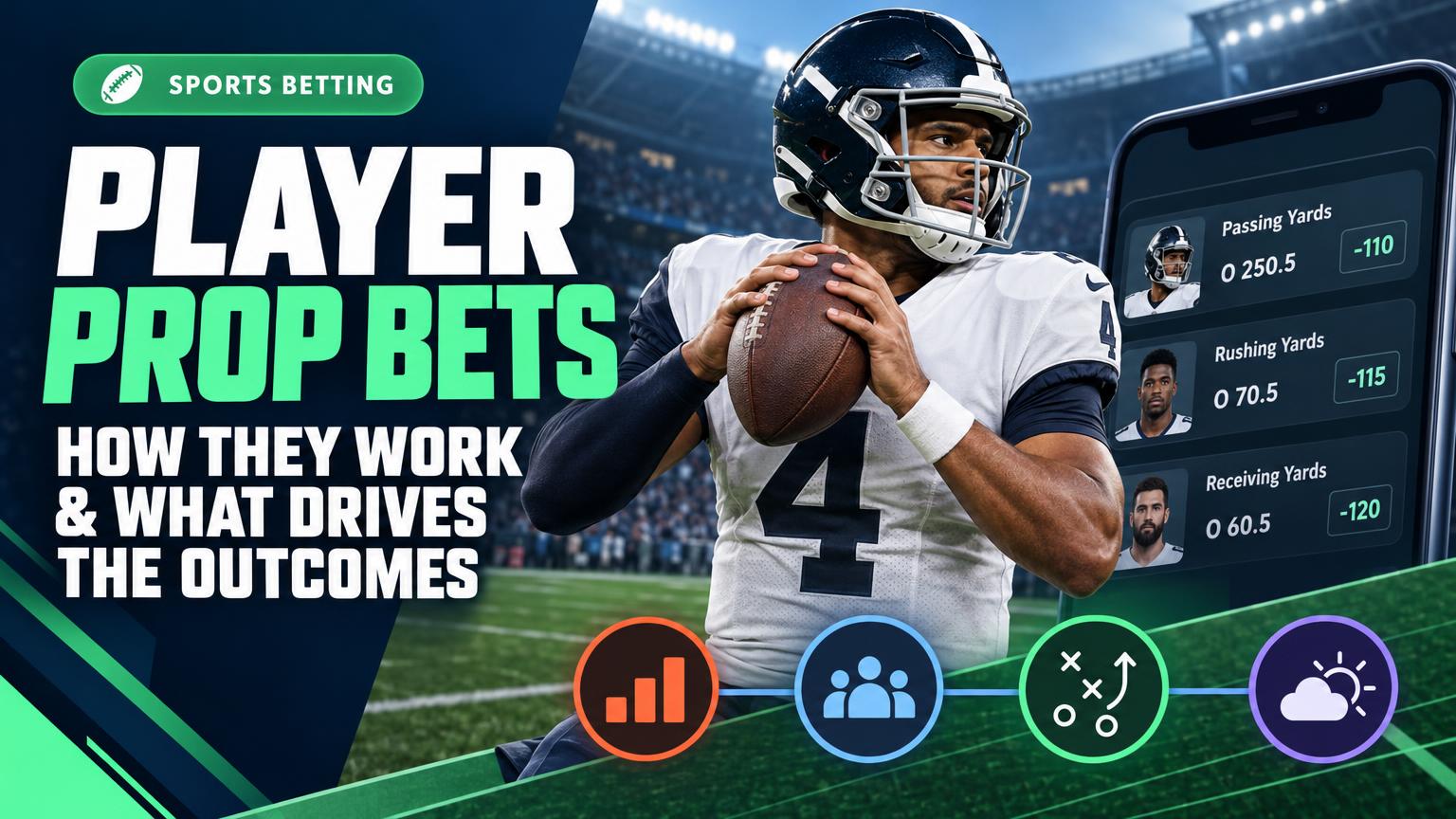
Suppose a sportsbook posts over/under 7.5 rebounds for a player. The line is 7.5: eight or more rebounds wins the over, while seven or fewer wins the under. The odds are separate numbers attached to each choice; they determine the payout on a winning bet and need not be the same for both sides. A line may stay at 7.5 even if the sportsbook changes those odds.
The player’s team can lose and an over-rebounds bet can still win. That distinction makes player props useful for following an individual performance, but it also makes the precise stat or action named in the market important.
Common types of player props
Player props generally ask one of three questions: how much a named player will produce, whether that player will do something, or whether that player will reach a milestone before anyone else.
Statistical totals set a line for an individual’s output. Examples include a basketball player’s points, a football receiver’s yards, or a baseball pitcher’s strikeouts. An over bet wins only if the recorded total exceeds the line; an under wins if it falls below.
Event outcomes ask whether a particular action happens. A quarterback to throw an interception, a batter to hit a home run, or a basketball player to record a double-double are examples. These markets may be offered as yes/no bets or as “anytime” selections.
First-to-reach markets name the player who achieves a milestone first, such as the first basket in a basketball game, first touchdown in a football game, or first hit in a baseball game. The order matters, not the player’s final total.
The named player is the key distinction from a game prop based on what either team does. “First player to score” targets an individual; “first team to score” does not. For first-to-reach bets, the sportsbook’s rules also determine what happens if nobody reaches the milestone.
What shapes player prop lines and odds?
A player prop line reflects an estimate of what a player will do, not a prediction that the player will land exactly on that number. Sportsbooks consider expected playing time and role: a starting guard expected to play heavy minutes may have a higher points line than a reserve, while a receiver’s target share can matter more than a team’s overall passing volume.
The matchup also matters. An opponent’s defensive approach, the likely pace of play, and game conditions can affect a player’s opportunities. Those factors are useful context, but none determines the result on its own.
Lines and odds can change as information arrives. An injury report, a confirmed lineup, or a change in expected minutes may lead a sportsbook to adjust a threshold, its odds, or both. Betting activity can also prompt adjustments. For example, a points line might stay at 20.5 while the price on the over changes.
The accepted bet slip, not an earlier listing, fixes the wager’s terms. Before a bet is accepted, the displayed line or odds may move. Once accepted, the wager is settled against the recorded result under that market’s rules—even if the sportsbook later posts a different line.
Top Sportsbook Picks for November 2026
BetUS
200% up to $1,000
Code:
NEW200
18+. Full T&C's apply.
18+. Full T&C's apply. Sports bonus: 100% match up to $500. Casino bonus: 100% match up to $500. Enter promo code NEW200 at deposit and get up to a $1000 bonus. Valid on your first three (3) deposits. Available for all deposit methods. Minimum deposit of $50.
18+. Full terms apply. The Bet Back Bonus is available for new customers on first-time deposits of $50 or more. To redeem, select the offer in the cashier while completing your first deposit. Make your pick(s) in the Sportsbook and then select ‘Opt In to Use Your Bonus’. A Bet Back Bonus pop-up will display, select ‘Claim’ and then enter the risk amount to place your bet. If it wins, you keep your profits. If it loses, get 100% of your risk refunded as Free Play with only 1-time rollover. Free Play can then be used to place bets in the Sportsbook and earn cash. Additional T&Cs apply, please visit MyBookie to access the Help Center or contact Live Chat for more details.
18+. Full T&C's apply. This promotion is available only to new accounts in North America. Freeplay amount must be wagered five times (5x rollover) before it becomes eligible for withdrawal. Only prematch (sportsbook) bets count toward the 5x rollover requirement. Each person may claim only one bonus. If a customer creates multiple accounts to exploit this promotion, bet105 will mark all related accounts as ineligible and reclaim the funds. If a client receives more than two free bets without making a deposit, any winnings from those bets will be forfeited. This promotion applies only to the initial deposit or if specifically assigned by bet105.
18+. Full terms apply. New BUSR members only. Minimum deposit of $50 required per qualifying deposits. Codes 300SB1, 300SB2, and 300SB3 must be entered at the time of each corresponding deposit.
Each code is valid one time only. Each bonus code must be claimed at least 24 hours apart. Only one promo code may be applied per deposit. A 20x rollover requirement applies to the combined total of your initial deposit and bonus before any withdrawal can be made. Redeemable in the Sportsbook only. BUSR management reserves the right to modify, suspend, or cancel this promotion at any time. Redeem each promo code in the cashier to get your bonus. Must be 18 or older. Please gamble responsibly. General House Rules Apply.
18+. Full terms apply. 100% up to $500 Bonus. Valid for non-crypto payment methods only. Minimum deposit amount $50. This offer is not available to customers from Canada or Mexico. The bonus code must be redeemed immediately after the deposit and before a wager has been placed. The sum of the deposit and the bonus are subject to rollover requirements of 12x at min. odds of -200 (1.5) before a new code can be redeemed. Max. $500 of each bet count towards the rollover requirements. Only bets placed on options that take place count towards the rollover requirements. Wagers on Horse Racing and Boosted Odds do not count towards the rollover requirements. All general Everygame Sportsbook rules apply.
21+. Full T&C's apply. Bonus: 35% of qualifying deposit, up to $105. Rollover: 8× (only sports action counts towards the rollover) deposit + bonus. Expiry: 7 days after credit. Hold period: 2 weeks. Payouts allowed only after rollover and hold period are completed. Example: Deposit $200 → Receive $50 Sports Free Play. Sports Free Play Rules: see the BetAnything General Reward Rules for eligible sports, wager types, odds, and rollover rules.
18+. Full T&C's apply. This bonus can only be redeemed on your first deposit. Rollover is 5x Sports/5x Horses/30x Casino on both the initial deposit and the bonus amount. Rollover in our Sportsbook, for winning wagers, will be determined by the lesser of your risk or win amount at the time of wager settlement; for losing wagers your risk amount will be credited to your rollover contribution. Bonus funds cannot be used for play on Live Dealer games. Live Dealer play does not count toward meeting Casino rollover requirements for withdrawal. If a withdrawal is made before the bonus terms are met, all bonus funds as well as any money earned by wagering the bonus will be forfeited.
Suppose a bettor takes the over on Jalen Brunson’s points at 24.5. The accepted line—not a later line shown by the sportsbook—is the threshold used to settle that bet.
02
Check the eligible period
In this example, the market covers Brunson’s full game, including overtime. A points total from regulation alone would not settle the bet if he also played in overtime. The sportsbook’s market rules determine which periods count.
03
Compare the recorded total
Suppose the official box score credits Brunson with 27 points for the eligible period. That clears 24.5, so the over wins and the under loses. If the recorded total were 24, the result would be reversed.
04
Contrast a yes/no event
A separate prop might ask whether Brunson records a steal. There is no points threshold to clear: “yes” wins if the official statistics credit him with at least one steal during the eligible period; “no” wins if they credit him with none.
05
Account for a possible push
Whole-number lines can end differently. If the accepted points line were 25 and Brunson finished with exactly 25, the bet may push under the sportsbook’s rules, typically returning the stake rather than paying a win or recording a loss.
These are hypothetical results; the accepted market terms and official statistics govern settlement.
When a player prop is voided
An injury does not determine whether a player prop is voided. The sportsbook’s participation rule does. A player who never enters the game will typically have pregame statistical props voided, with the stake returned. But once the player meets the market’s participation requirement, an injury usually does not erase the bet.
Consider a points over/under. If the player leaves early with fewer points than the line, the over may lose and the under may win—even if the injury made the result feel inevitable. A few seconds on the court or a single snap can be enough at some sportsbooks, while other sports or markets require a stated minimum. Brief participation is therefore different from no appearance, but it is not always enough to make a bet stand.
Markets can have their own exceptions. A first-touchdown prop, for example, may use different eligibility terms from a rushing-yards total at the same sportsbook. Check the rule for the specific market, not just a general statement about player props.
Postponements add a separate question: whether the game is played within the sportsbook’s permitted window. Some bets remain open if play resumes or the game is rescheduled soon enough; others are voided. Before placing a prop, the useful details to find are the participation threshold, the applicable game-time window, and what happens if the player starts but exits early.
A void is not a loss
A voided prop returns the stake. If the player qualified under the participation rule, the prop generally settles on the recorded result—even after an early injury.
Which stats and minutes count?
A player prop can look settled when the clock expires, but the market’s time period determines which plays count. A full-game total may include overtime, while a regulation-only market stops at the end of the scheduled game. A first-half or single-quarter prop generally excludes later periods, even if the player adds the relevant stat afterward. The bet slip and house rules are more reliable than assumptions based on a familiar box score.
Official statistics can also change after an initial result appears. A league may reassign an assist or correct a credited yard, and a sportsbook may update its grading if the correction falls within its stated settlement window. Some operators treat an earlier result as final after a cutoff. The posted rules and the sportsbook’s named data source govern whether a later correction affects the bet.
Definitions matter most when a market name sounds broader than it is:
Assists: Credit depends on the official scorer or data provider, not simply whether a pass led to a score. Leagues may apply different criteria.
First scorer: Check whether the market means the game’s first points, a team’s first points, or the first player to score by a specified method. In basketball, “first basket” and “first scorer” may differ if the opening points come from free throws.
Before comparing a result with a bet slip, check the exact market wording, period, and stated statistical source.
Comparing books
What to compare across offshore sportsbooks
01
Prop selection and parlays
A broad menu may include alternate lines and less prominent players, but markets can vary by sport and event. Same-game parlay eligibility is a separate feature: a listed prop may not be available in a parlay.
Look for
Props available for the sports and players of interest
Watch for
Assuming every listed prop qualifies for a parlay
02
Accepted limits
The amount a book accepts can differ by market and may change before a bet is placed. A deep menu is less useful if the relevant props have restrictive limits.
Look for
Limits shown before confirmation
Watch for
Treating advertised maximums as universal
03
Participation and market wording
Check whether a player must appear, start, or meet another condition for the bet to count. Similar-looking props can also cover different periods, such as regulation only or the full game.
Look for
Specific eligibility and time-period rules
Watch for
Assuming matching names mean matching terms
04
Stats and settlement
Terms may name a stat provider, set a correction cutoff, and explain how postponements or disputed results are handled. Prop variety and parlay features do not establish licensing, reliability, or favorable settlement terms.
Player: Confirm the named athlete and team, especially after a trade or lineup change.
Market: Check the exact statistic or event; points, points plus assists, and first basket are different bets.
Line and odds: Read the threshold and accepted price. The line determines what must happen; the odds determine the payout if it wins or pushes are excluded by the market terms potentially? no need).
A player’s recorded performance supplies the result, but the accepted market terms determine how the sportsbook settles it. A final box score alone may not answer whether overtime counted, an appearance qualified, or a later stat correction applies.
Top Sportsbook Picks for November 2026
BetUS
200% up to $1,000
Code:
NEW200
18+. Full T&C's apply.
18+. Full T&C's apply. Sports bonus: 100% match up to $500. Casino bonus: 100% match up to $500. Enter promo code NEW200 at deposit and get up to a $1000 bonus. Valid on your first three (3) deposits. Available for all deposit methods. Minimum deposit of $50.
18+. Full terms apply. The Bet Back Bonus is available for new customers on first-time deposits of $50 or more. To redeem, select the offer in the cashier while completing your first deposit. Make your pick(s) in the Sportsbook and then select ‘Opt In to Use Your Bonus’. A Bet Back Bonus pop-up will display, select ‘Claim’ and then enter the risk amount to place your bet. If it wins, you keep your profits. If it loses, get 100% of your risk refunded as Free Play with only 1-time rollover. Free Play can then be used to place bets in the Sportsbook and earn cash. Additional T&Cs apply, please visit MyBookie to access the Help Center or contact Live Chat for more details.
18+. Full T&C's apply. This promotion is available only to new accounts in North America. Freeplay amount must be wagered five times (5x rollover) before it becomes eligible for withdrawal. Only prematch (sportsbook) bets count toward the 5x rollover requirement. Each person may claim only one bonus. If a customer creates multiple accounts to exploit this promotion, bet105 will mark all related accounts as ineligible and reclaim the funds. If a client receives more than two free bets without making a deposit, any winnings from those bets will be forfeited. This promotion applies only to the initial deposit or if specifically assigned by bet105.
18+. Full terms apply. New BUSR members only. Minimum deposit of $50 required per qualifying deposits. Codes 300SB1, 300SB2, and 300SB3 must be entered at the time of each corresponding deposit.
Each code is valid one time only. Each bonus code must be claimed at least 24 hours apart. Only one promo code may be applied per deposit. A 20x rollover requirement applies to the combined total of your initial deposit and bonus before any withdrawal can be made. Redeemable in the Sportsbook only. BUSR management reserves the right to modify, suspend, or cancel this promotion at any time. Redeem each promo code in the cashier to get your bonus. Must be 18 or older. Please gamble responsibly. General House Rules Apply.
18+. Full terms apply. 100% up to $500 Bonus. Valid for non-crypto payment methods only. Minimum deposit amount $50. This offer is not available to customers from Canada or Mexico. The bonus code must be redeemed immediately after the deposit and before a wager has been placed. The sum of the deposit and the bonus are subject to rollover requirements of 12x at min. odds of -200 (1.5) before a new code can be redeemed. Max. $500 of each bet count towards the rollover requirements. Only bets placed on options that take place count towards the rollover requirements. Wagers on Horse Racing and Boosted Odds do not count towards the rollover requirements. All general Everygame Sportsbook rules apply.
21+. Full T&C's apply. Bonus: 35% of qualifying deposit, up to $105. Rollover: 8× (only sports action counts towards the rollover) deposit + bonus. Expiry: 7 days after credit. Hold period: 2 weeks. Payouts allowed only after rollover and hold period are completed. Example: Deposit $200 → Receive $50 Sports Free Play. Sports Free Play Rules: see the BetAnything General Reward Rules for eligible sports, wager types, odds, and rollover rules.
18+. Full T&C's apply. This bonus can only be redeemed on your first deposit. Rollover is 5x Sports/5x Horses/30x Casino on both the initial deposit and the bonus amount. Rollover in our Sportsbook, for winning wagers, will be determined by the lesser of your risk or win amount at the time of wager settlement; for losing wagers your risk amount will be credited to your rollover contribution. Bonus funds cannot be used for play on Live Dealer games. Live Dealer play does not count toward meeting Casino rollover requirements for withdrawal. If a withdrawal is made before the bonus terms are met, all bonus funds as well as any money earned by wagering the bonus will be forfeited.