18+. Full T&C's apply. Sports bonus: 100% match up to $500. Casino bonus: 100% match up to $500. Enter promo code NEW200 at deposit and get up to a $1000 bonus. Valid on your first three (3) deposits. Available for all deposit methods. Minimum deposit of $50.
18+. Full terms apply. The Bet Back Bonus is available for new customers on first-time deposits of $50 or more. To redeem, select the offer in the cashier while completing your first deposit. Make your pick(s) in the Sportsbook and then select ‘Opt In to Use Your Bonus’. A Bet Back Bonus pop-up will display, select ‘Claim’ and then enter the risk amount to place your bet. If it wins, you keep your profits. If it loses, get 100% of your risk refunded as Free Play with only 1-time rollover. Free Play can then be used to place bets in the Sportsbook and earn cash. Additional T&Cs apply, please visit MyBookie to access the Help Center or contact Live Chat for more details.
18+. Full T&C's apply. This promotion is available only to new accounts in North America. Freeplay amount must be wagered five times (5x rollover) before it becomes eligible for withdrawal. Only prematch (sportsbook) bets count toward the 5x rollover requirement. Each person may claim only one bonus. If a customer creates multiple accounts to exploit this promotion, bet105 will mark all related accounts as ineligible and reclaim the funds. If a client receives more than two free bets without making a deposit, any winnings from those bets will be forfeited. This promotion applies only to the initial deposit or if specifically assigned by bet105.
18+. Full terms apply. New BUSR members only. Minimum deposit of $50 required per qualifying deposits. Codes 300SB1, 300SB2, and 300SB3 must be entered at the time of each corresponding deposit.
Each code is valid one time only. Each bonus code must be claimed at least 24 hours apart. Only one promo code may be applied per deposit. A 20x rollover requirement applies to the combined total of your initial deposit and bonus before any withdrawal can be made. Redeemable in the Sportsbook only. BUSR management reserves the right to modify, suspend, or cancel this promotion at any time. Redeem each promo code in the cashier to get your bonus. Must be 18 or older. Please gamble responsibly. General House Rules Apply.
18+. Full terms apply. 100% up to $500 Bonus. Valid for non-crypto payment methods only. Minimum deposit amount $50. This offer is not available to customers from Canada or Mexico. The bonus code must be redeemed immediately after the deposit and before a wager has been placed. The sum of the deposit and the bonus are subject to rollover requirements of 12x at min. odds of -200 (1.5) before a new code can be redeemed. Max. $500 of each bet count towards the rollover requirements. Only bets placed on options that take place count towards the rollover requirements. Wagers on Horse Racing and Boosted Odds do not count towards the rollover requirements. All general Everygame Sportsbook rules apply.
21+. Full T&C's apply. Bonus: 35% of qualifying deposit, up to $105. Rollover: 8× (only sports action counts towards the rollover) deposit + bonus. Expiry: 7 days after credit. Hold period: 2 weeks. Payouts allowed only after rollover and hold period are completed. Example: Deposit $200 → Receive $50 Sports Free Play. Sports Free Play Rules: see the BetAnything General Reward Rules for eligible sports, wager types, odds, and rollover rules.
18+. Full T&C's apply. This bonus can only be redeemed on your first deposit. Rollover is 5x Sports/5x Horses/30x Casino on both the initial deposit and the bonus amount. Rollover in our Sportsbook, for winning wagers, will be determined by the lesser of your risk or win amount at the time of wager settlement; for losing wagers your risk amount will be credited to your rollover contribution. Bonus funds cannot be used for play on Live Dealer games. Live Dealer play does not count toward meeting Casino rollover requirements for withdrawal. If a withdrawal is made before the bonus terms are met, all bonus funds as well as any money earned by wagering the bonus will be forfeited.
The second pick is where the rules get interesting.
A bettor adds a quarterback’s passing-yards over, then finds that the same player’s touchdown-pass over cannot go on the slip. The outcomes are related: a sportsbook may block the pairing or offer it through a same game parlay builder, which accounts for that relationship rather than simply multiplying the standalone odds.
Eligible combinations vary by sportsbook and event. The builder shows which picks can be paired, while the final bet slip shows the offered odds and potential payout before the wager is submitted. If the return looks lower than expected, correlation may be the reason. The operator’s parlay rules can clarify restrictions and settlement terms; supported markets may differ across offshore books.
What makes a parlay a same game parlay?
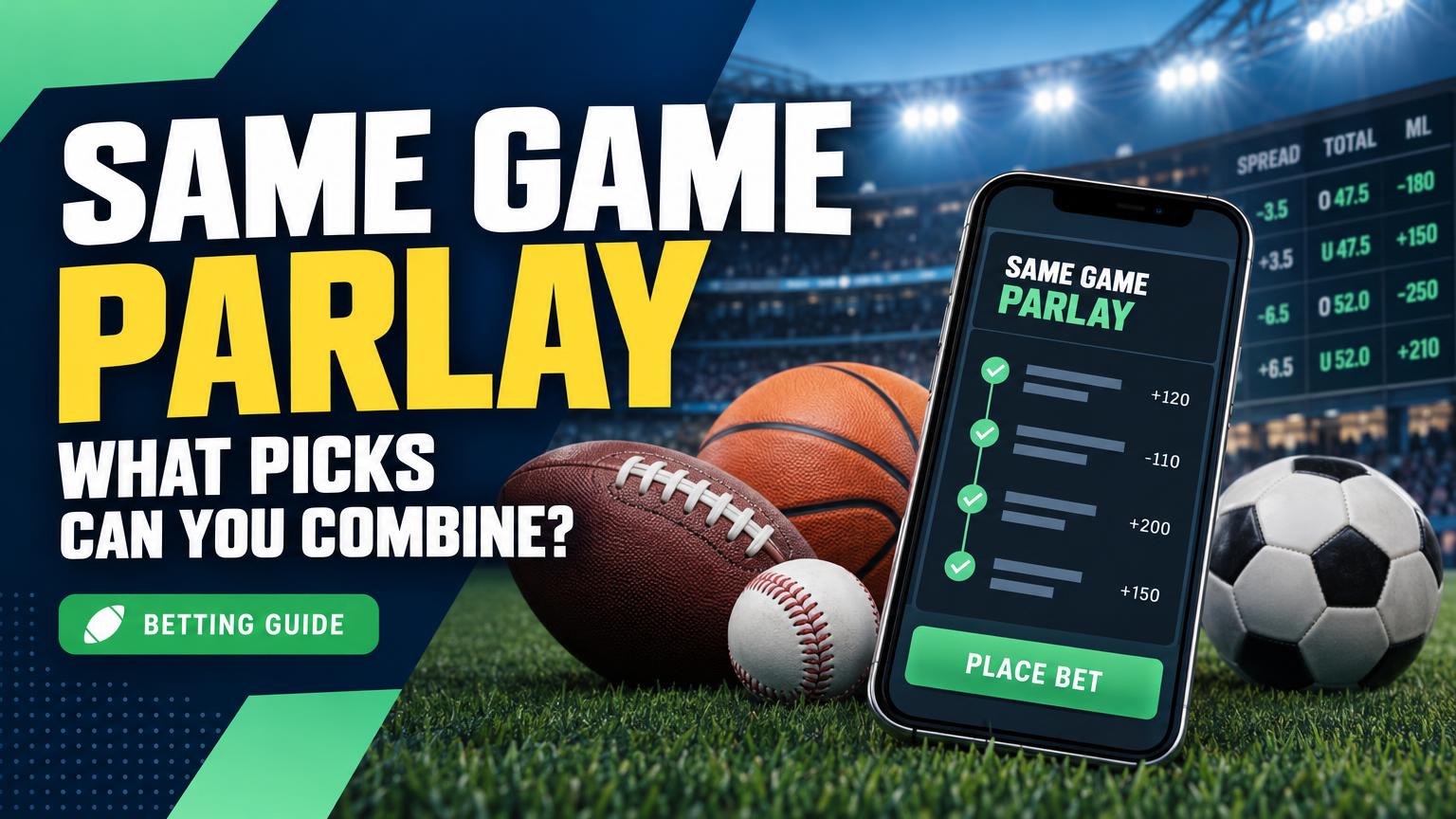
A same game parlay (SGP) puts two or more eligible selections from one event on a single ticket. An NFL SGP, for example, might pair a quarterback to exceed a passing-yard line with his team to win. Every leg generally needs to win for the wager to pay; if one loses, the whole SGP typically loses. Sportsbooks also account for relationships between picks when setting the combined odds.
The distinction is the event, not the number of picks. Two winners from separate NFL games make a standard parlay, not an SGP. The guide to sports wager types explains how parlays fit alongside other bets.
Some sportsbooks offer a feature that combines multiple SGPs from different games into one larger wager. That is different from a single-game SGP, even though each component contains picks from one event. Availability and eligible combinations vary by sportsbook; a market appearing in the bet slip does not necessarily mean it can be paired with every other pick.
Which picks can go in a same game parlay?
Same game parlays commonly draw from game lines, totals, and player props. The table shows plausible two-pick combinations, not a promise that every sportsbook will accept them.
Market mix
Football example
Basketball example
Game result + total
Team moneyline + game over
Team moneyline + game under
Spread + player prop
Team spread + quarterback passing yards over
Team spread + player rebounds over
Total + player prop
Game over + receiver yards over
Game over + player points over
Two player props
Quarterback passing yards over + receiver yards over
Player assists over + teammate points over
Both markets must appear in that sportsbook’s SGP builder, and the builder must accept them together. An operator may offer a prop as a standalone bet but exclude it from SGPs. It may also reject a pairing because the picks are closely related, or offer different combinations and adjusted odds instead. A quarterback’s passing yards over paired with a receiver’s yards over is a useful example: both outcomes can rise together, so availability and pricing matter more than whether each pick appears on the main betting menu.
A player prop’s threshold is the line the bet must beat—for example, over 24.5 points. That line does not determine which baskets count. The result depends on the sportsbook’s settlement rules and the official statistics it uses; how player prop results are determined explains why a postgame stat correction or a player who does not participate can affect grading. Before placing an SGP, the practical check is simple: confirm both selections remain on the slip and review the displayed combined odds and applicable rules.
Common misconceptions
Why some same-game picks cannot be combined
Myth
Any two picks from the same game can go in one parlay.
Fact
A sportsbook’s builder determines which markets and combinations are eligible. Two available picks may still be unavailable together.
Why it matters
A game total and a player passing prop, for example, may rise or fall together. Rather than multiply their standalone odds, the sportsbook may offer a different combined price—or decline the pairing.
Myth
If both picks appear in the builder, they can be opposite sides of the same result.
Fact
Mutually exclusive outcomes, such as one team to win and its opponent to win in a game without a draw, cannot both succeed.
Why it matters
A parlay needs every leg to win. Some apparently different markets also conflict: a team cannot both win outright and lose by more than the specified margin.
Myth
Any correlation between picks makes the combination prohibited.
Fact
Correlation can affect pricing without ruling out the bet. A quarterback’s passing yards and a receiver’s receiving yards may be offered together at adjusted odds.
Why it matters
Overlapping picks need separate scrutiny. A player to score 25+ points already satisfies a 20+ points pick, so the second leg adds no independent hurdle. Books may restrict that combination or account for the overlap in the price.
Checking a combination
How to check whether picks can be combined
01
Open the same game parlay builder
Start from the event’s SGP builder, if available. An event page may display many markets without indicating which ones the sportsbook permits in the same bet.
02
Add the first leg, then test a second
For example, add a football spread and then try a quarterback passing-yards prop. The slip—not the list of available markets—shows whether that particular pairing is accepted.
03
Read any rejection or adjustment
A rejected leg may be incompatible with the existing pick or unavailable for SGPs. If the slip accepts both, check the combined odds: they may differ from a simple multiplication of the individual prices.
04
Check every added leg
A third pick can make an otherwise accepted two-leg combination ineligible. Review the full slip after each addition rather than assuming each accepted pair will work together.
05
Review the slip again before placing the bet
Markets and prices can change as lines move or game time approaches. Confirm that all intended legs remain on the slip and that the displayed combined odds and any notices still match the intended wager.
Availability and bet-slip messages vary by sportsbook; a combination accepted earlier may not remain available.
Why SGP odds differ from standalone odds
Standalone odds do not always predict the price of a same game parlay. A sportsbook may adjust the combined price when two picks are related: a strong passing game, for example, could help both a quarterback’s passing-yards over and a receiver’s receiving-yards over hit.
Top Sportsbook Picks for November 2026
BetUS
200% up to $1,000
Code:
NEW200
18+. Full T&C's apply.
18+. Full T&C's apply. Sports bonus: 100% match up to $500. Casino bonus: 100% match up to $500. Enter promo code NEW200 at deposit and get up to a $1000 bonus. Valid on your first three (3) deposits. Available for all deposit methods. Minimum deposit of $50.
18+. Full terms apply. The Bet Back Bonus is available for new customers on first-time deposits of $50 or more. To redeem, select the offer in the cashier while completing your first deposit. Make your pick(s) in the Sportsbook and then select ‘Opt In to Use Your Bonus’. A Bet Back Bonus pop-up will display, select ‘Claim’ and then enter the risk amount to place your bet. If it wins, you keep your profits. If it loses, get 100% of your risk refunded as Free Play with only 1-time rollover. Free Play can then be used to place bets in the Sportsbook and earn cash. Additional T&Cs apply, please visit MyBookie to access the Help Center or contact Live Chat for more details.
18+. Full T&C's apply. This promotion is available only to new accounts in North America. Freeplay amount must be wagered five times (5x rollover) before it becomes eligible for withdrawal. Only prematch (sportsbook) bets count toward the 5x rollover requirement. Each person may claim only one bonus. If a customer creates multiple accounts to exploit this promotion, bet105 will mark all related accounts as ineligible and reclaim the funds. If a client receives more than two free bets without making a deposit, any winnings from those bets will be forfeited. This promotion applies only to the initial deposit or if specifically assigned by bet105.
18+. Full terms apply. New BUSR members only. Minimum deposit of $50 required per qualifying deposits. Codes 300SB1, 300SB2, and 300SB3 must be entered at the time of each corresponding deposit.
Each code is valid one time only. Each bonus code must be claimed at least 24 hours apart. Only one promo code may be applied per deposit. A 20x rollover requirement applies to the combined total of your initial deposit and bonus before any withdrawal can be made. Redeemable in the Sportsbook only. BUSR management reserves the right to modify, suspend, or cancel this promotion at any time. Redeem each promo code in the cashier to get your bonus. Must be 18 or older. Please gamble responsibly. General House Rules Apply.
18+. Full terms apply. 100% up to $500 Bonus. Valid for non-crypto payment methods only. Minimum deposit amount $50. This offer is not available to customers from Canada or Mexico. The bonus code must be redeemed immediately after the deposit and before a wager has been placed. The sum of the deposit and the bonus are subject to rollover requirements of 12x at min. odds of -200 (1.5) before a new code can be redeemed. Max. $500 of each bet count towards the rollover requirements. Only bets placed on options that take place count towards the rollover requirements. Wagers on Horse Racing and Boosted Odds do not count towards the rollover requirements. All general Everygame Sportsbook rules apply.
21+. Full T&C's apply. Bonus: 35% of qualifying deposit, up to $105. Rollover: 8× (only sports action counts towards the rollover) deposit + bonus. Expiry: 7 days after credit. Hold period: 2 weeks. Payouts allowed only after rollover and hold period are completed. Example: Deposit $200 → Receive $50 Sports Free Play. Sports Free Play Rules: see the BetAnything General Reward Rules for eligible sports, wager types, odds, and rollover rules.
18+. Full T&C's apply. This bonus can only be redeemed on your first deposit. Rollover is 5x Sports/5x Horses/30x Casino on both the initial deposit and the bonus amount. Rollover in our Sportsbook, for winning wagers, will be determined by the lesser of your risk or win amount at the time of wager settlement; for losing wagers your risk amount will be credited to your rollover contribution. Bonus funds cannot be used for play on Live Dealer games. Live Dealer play does not count toward meeting Casino rollover requirements for withdrawal. If a withdrawal is made before the bonus terms are met, all bonus funds as well as any money earned by wagering the bonus will be forfeited.
The +240 figure is an example, not a quoted offer. If both picks were independent, multiplying their decimal odds would produce +300. But when the outcomes are positively related, a sportsbook might offer a lower payout on the combination. Different operators can price the same pair differently, and available lines may change before a wager is placed.
Adding another eligible leg can increase the potential payout, but it also adds another result that must go right. Even a plausible three-pick SGP loses if one pick falls short. The final price on the bet slip—not a calculation from each pick’s standalone odds—is the price to check before placing the bet.
What happens if an SGP leg loses or is void?
A graded losing leg is different from a leg that never receives a win-or-loss result. If a player prop is graded as a loss because the player took part but missed the target, the SGP generally loses, even if every other pick wins. The same distinction applies to what happens when a parlay leg loses outside an SGP.
A push or void may occur when a line lands exactly on its number, a player does not participate, or a market is canceled. Those outcomes are not interchangeable across sportsbooks. A player’s brief appearance, for example, may be enough for a prop to stand under one set of rules, while a specific market may have its own minimum-participation requirement.
If one SGP leg is void, an operator may recalculate the bet using the remaining eligible picks, void the entire wager, or apply a rule specific to that market. Recalculation should not be assumed to mean simply dividing out the void leg’s displayed odds: the remaining picks may still be correlated and require a new combined price. A canceled game can also be treated differently from a single canceled prop.
Check the settlement rule, not just the bet slip
Before placing an SGP with player props, check the sportsbook’s published rules for nonparticipation, pushes, and canceled markets. The graded result should be checked against those terms if a leg is later voided.
House rules
Check the sportsbook’s SGP rules
Confirm the sport and markets
SGP availability can vary by league, event, and bet type. A comparison of parlay rules across sportsbooks can show whether player props or alternate lines qualify.
Check the leg limit
Sportsbooks may set minimum and maximum leg counts, sometimes with different limits for particular sports or promotions. The bet slip shows whether the proposed SGP fits.
Test restricted pairings
Two markets may be offered separately but blocked together. The builder may reject a pairing or change the displayed odds as legs are added.
Check live-betting availability
An operator may allow pregame SGPs but offer fewer live markets, or none for a particular event. Available legs can also change during play.
Read the void rules
Check whether a voided leg leads to repricing or cancellation, especially for player props. The applicable house rules determine settlement; the original combined odds may not remain in place.
Review promotion terms separately
An SGP boost or bonus may require eligible markets, a minimum leg count, or qualifying odds. An accepted bet does not necessarily qualify for a promotion.
The SGP name does not establish common rules, particularly across offshore sportsbooks. Check the house rules and final bet slip before placing a wager.
Conclusion
A same game parlay is eligible only when its picks come from the same event, appear in the sportsbook’s SGP builder, and remain accepted together on the bet slip. Before placing it, the bettor also needs to understand the final combined odds and how the book handles voids, pushes, and official-stat corrections.
An accepted bet is not necessarily a good bet. The builder confirms that a combination is available, not that its price offers value. If the payout, settlement terms, or possible loss is unclear, the bet can be left unplaced.
Top Sportsbook Picks for November 2026
BetUS
200% up to $1,000
Code:
NEW200
18+. Full T&C's apply.
18+. Full T&C's apply. Sports bonus: 100% match up to $500. Casino bonus: 100% match up to $500. Enter promo code NEW200 at deposit and get up to a $1000 bonus. Valid on your first three (3) deposits. Available for all deposit methods. Minimum deposit of $50.
18+. Full terms apply. The Bet Back Bonus is available for new customers on first-time deposits of $50 or more. To redeem, select the offer in the cashier while completing your first deposit. Make your pick(s) in the Sportsbook and then select ‘Opt In to Use Your Bonus’. A Bet Back Bonus pop-up will display, select ‘Claim’ and then enter the risk amount to place your bet. If it wins, you keep your profits. If it loses, get 100% of your risk refunded as Free Play with only 1-time rollover. Free Play can then be used to place bets in the Sportsbook and earn cash. Additional T&Cs apply, please visit MyBookie to access the Help Center or contact Live Chat for more details.
18+. Full T&C's apply. This promotion is available only to new accounts in North America. Freeplay amount must be wagered five times (5x rollover) before it becomes eligible for withdrawal. Only prematch (sportsbook) bets count toward the 5x rollover requirement. Each person may claim only one bonus. If a customer creates multiple accounts to exploit this promotion, bet105 will mark all related accounts as ineligible and reclaim the funds. If a client receives more than two free bets without making a deposit, any winnings from those bets will be forfeited. This promotion applies only to the initial deposit or if specifically assigned by bet105.
18+. Full terms apply. New BUSR members only. Minimum deposit of $50 required per qualifying deposits. Codes 300SB1, 300SB2, and 300SB3 must be entered at the time of each corresponding deposit.
Each code is valid one time only. Each bonus code must be claimed at least 24 hours apart. Only one promo code may be applied per deposit. A 20x rollover requirement applies to the combined total of your initial deposit and bonus before any withdrawal can be made. Redeemable in the Sportsbook only. BUSR management reserves the right to modify, suspend, or cancel this promotion at any time. Redeem each promo code in the cashier to get your bonus. Must be 18 or older. Please gamble responsibly. General House Rules Apply.
18+. Full terms apply. 100% up to $500 Bonus. Valid for non-crypto payment methods only. Minimum deposit amount $50. This offer is not available to customers from Canada or Mexico. The bonus code must be redeemed immediately after the deposit and before a wager has been placed. The sum of the deposit and the bonus are subject to rollover requirements of 12x at min. odds of -200 (1.5) before a new code can be redeemed. Max. $500 of each bet count towards the rollover requirements. Only bets placed on options that take place count towards the rollover requirements. Wagers on Horse Racing and Boosted Odds do not count towards the rollover requirements. All general Everygame Sportsbook rules apply.
21+. Full T&C's apply. Bonus: 35% of qualifying deposit, up to $105. Rollover: 8× (only sports action counts towards the rollover) deposit + bonus. Expiry: 7 days after credit. Hold period: 2 weeks. Payouts allowed only after rollover and hold period are completed. Example: Deposit $200 → Receive $50 Sports Free Play. Sports Free Play Rules: see the BetAnything General Reward Rules for eligible sports, wager types, odds, and rollover rules.
18+. Full T&C's apply. This bonus can only be redeemed on your first deposit. Rollover is 5x Sports/5x Horses/30x Casino on both the initial deposit and the bonus amount. Rollover in our Sportsbook, for winning wagers, will be determined by the lesser of your risk or win amount at the time of wager settlement; for losing wagers your risk amount will be credited to your rollover contribution. Bonus funds cannot be used for play on Live Dealer games. Live Dealer play does not count toward meeting Casino rollover requirements for withdrawal. If a withdrawal is made before the bonus terms are met, all bonus funds as well as any money earned by wagering the bonus will be forfeited.